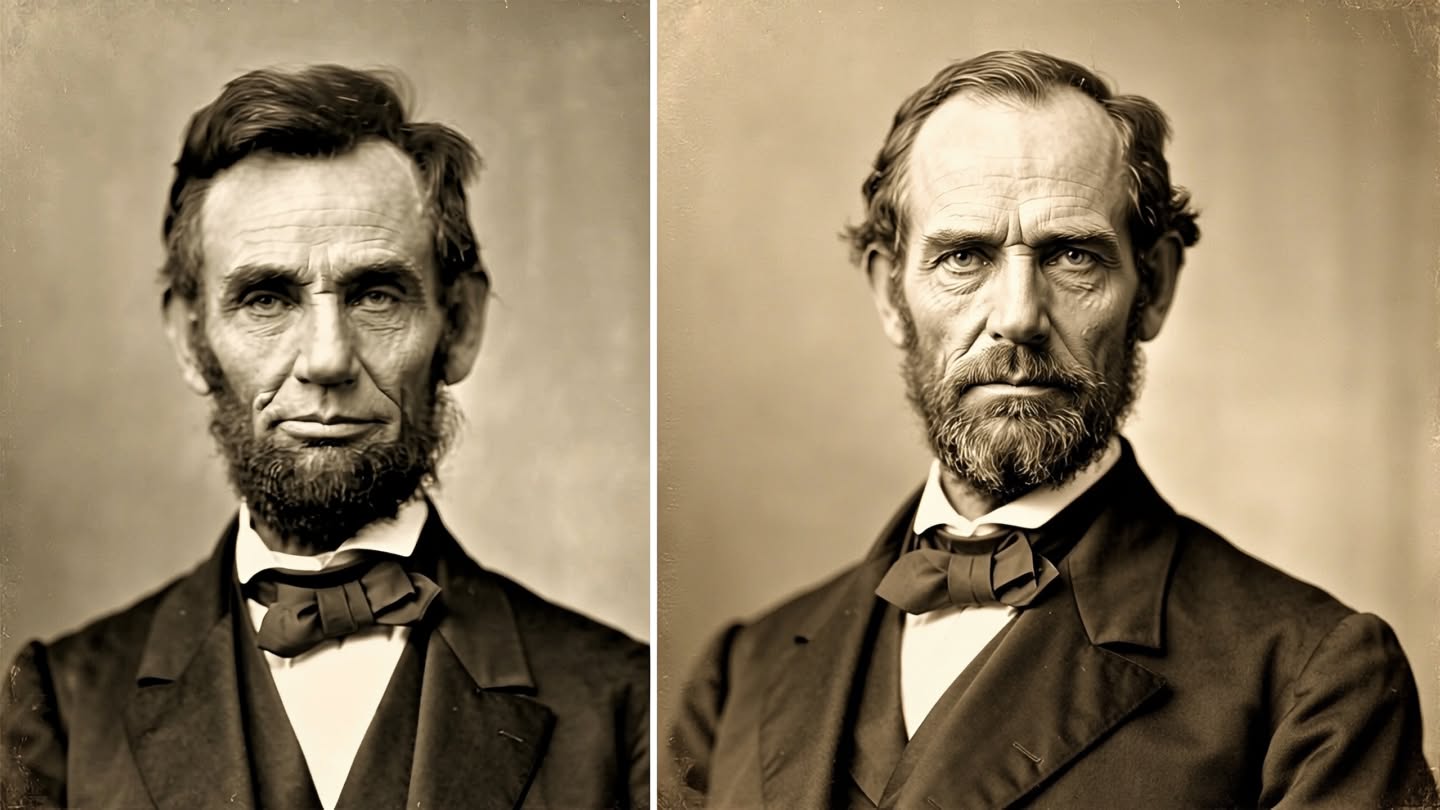
Abraham Lincoln vs Jefferson Davis: Civil War Leaders Compared
The American Civil War from 1861 to 1865 was more than a battle between armies. It was also a contest between two very different leaders. Abraham Lincoln led the United States, or the Union. Jefferson Davis led the Confederate States of America. Both men shaped the course of the war and the future of the country.
- Early Life and Political Backgrounds
Abraham Lincoln was born in 1809 in a log cabin in Kentucky. He had very little formal schooling. He worked as a laborer, storekeeper, and self-taught lawyer. Lincoln served one term in the U.S. House of Representatives in the 1840s. He became nationally known during the 1858 Senate debates against Stephen Douglas, where he argued against the expansion of slavery.
Jefferson Davis was born in 1808 in Kentucky, just 100 miles from Lincoln’s birthplace. His path was very different. Davis graduated from the U.S. Military Academy at West Point. He served as an officer in the army, U.S. Senator from Mississippi, and U.S. Secretary of War under President Franklin Pierce. He had extensive military and government experience before the war.
So right away we see a contrast: Lincoln was a self-made lawyer with limited Washington experience. Davis was a West Point-trained soldier and longtime politician.
- Their Main Goals During the War
Lincoln’s Goal: At first, Lincoln’s main goal was to preserve the Union. He stated that if he could save the Union without freeing any slaves, he would do it. But as the war continued, his goal expanded. The Emancipation Proclamation in 1863 made ending slavery a central aim of the war. For Lincoln, the war became a fight for both national unity and human freedom.
Davis’s Goal: Jefferson Davis’s main goal was to win independence for the Confederacy. He wanted the Confederate States to be recognized as a separate, sovereign nation. The Confederacy argued for states’ rights, especially the right to maintain slavery. Davis needed to defend Confederate territory and gain foreign recognition from countries like Britain and France.
- Leadership Styles: How They Managed the War
Lincoln as a Leader: Lincoln had no military training, but he learned quickly. He was patient with his generals but also willing to fire them if they failed. He replaced generals like McClellan and Burnside until he found Ulysses S. Grant. Lincoln focused on the big picture. He understood that public opinion in the North was crucial. He used speeches like the Gettysburg Address to explain why the war mattered. He also managed a complex political cabinet with rivals like William Seward and Salmon Chase.
Davis as a Leader: Davis was a trained soldier, so he often involved himself in military details. He sometimes argued with his own generals, including Joseph Johnston and P.G.T. Beauregard. This caused tension. Davis also had a harder job politically. The Confederacy was founded on states’ rights. That meant individual Confederate states often refused to send troops or supplies to the central government in Richmond. Davis struggled to create a unified national effort.
- Key Challenges Each Leader Faced
The Union and Confederacy faced very different problems during the war.
Economy: The Union had a strong industrial base. It could produce weapons, ships, and railroads. The Confederacy was agriculture-based with few factories and depended on cotton exports.
Population: The Union had 22 million people, giving it a large pool for army recruitment. The Confederacy had 9 million people, including 3.5 million enslaved, which meant a smaller army.
Foreign Support: Lincoln’s government blocked Confederate diplomacy and Britain stayed neutral. Davis failed to get official recognition from Britain or France.
Internal Politics: Lincoln faced opposition from “Copperheads” who wanted peace. Davis found that states’ rights made central control difficult because governors often resisted his orders.
- Major Decisions That Changed the War
Lincoln’s Key Decisions:
First, The Emancipation Proclamation in 1863. This freed slaves in Confederate states. It changed the moral purpose of the war and stopped Britain from supporting the Confederacy.
Second, Choosing Grant and Sherman. Lincoln promoted Ulysses S. Grant to command all Union armies in 1864. He supported Sherman’s March to the Sea, which damaged Confederate morale and resources.
Third, The Gettysburg Address. In 272 words, Lincoln reframed the war as a test of democracy and equality.
Davis’s Key Decisions:
First, Firing on Fort Sumter in 1861. Davis approved the attack on the federal fort in South Carolina. This started the war and united the North against the Confederacy.
Second, Defensive Strategy. For much of the war, Davis preferred to fight defensively and wait for the North to get tired. General Robert E. Lee sometimes disagreed and pushed for invasions of the North.
Third, Centralizing Power. Davis tried to draft soldiers and take control of supplies, but state governors often blocked him. This hurt the Confederate war effort.
- The Outcome and Their Legacies
By April 1865, the Confederacy collapsed. General Lee surrendered to Grant at Appomattox Court House. Jefferson Davis was captured a month later. He was imprisoned for two years but never tried for treason. He lived until 1889 and wrote books defending the Confederate cause.
Abraham Lincoln did not live to see the peace. He was assassinated on April 14, 1865, just days after the war ended. He is remembered for preserving the Union, ending slavery, and strengthening the federal government. The 13th Amendment, which abolished slavery, was passed because of his leadership.
Final Comparison: Why Lincoln’s Approach Worked
Both men