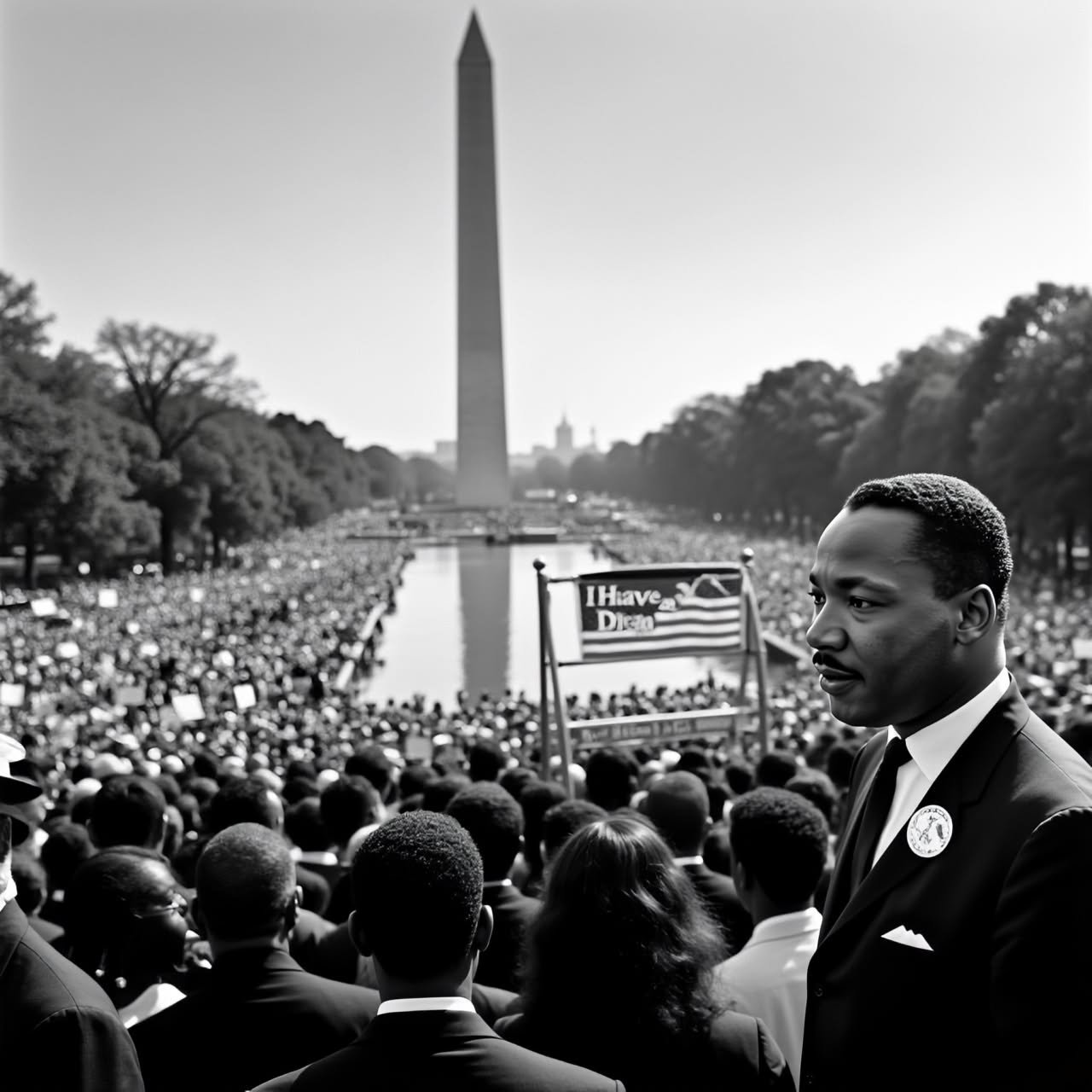
Martin Luther King Jr was the most important leader of the American Civil Rights Movement in the 1950s and 1960s. He used nonviolent protest to fight segregation and racial discrimination. His words and actions helped change laws and gave equal rights to millions of African Americans.
Early Life 1929-1955
Martin Luther King Jr was born on January 15, 1929, in Atlanta, Georgia. His father was a Baptist minister. King was a smart student. He skipped two grades and entered college at age 15. He earned a doctorate in theology from Boston University in 1955. That same year, he became pastor of Dexter Avenue Baptist Church in Montgomery, Alabama. King studied Mahatma Gandhi’s ideas of nonviolent resistance and believed they could work in America.
Montgomery Bus Boycott 1955-1956
On December 1, 1955, Rosa Parks refused to give up her bus seat to a white passenger in Montgomery. She was arrested. Black leaders chose King to lead a boycott of city buses. For 381 days, African Americans walked or shared rides instead of using buses. The boycott hurt the bus company’s income. In 1956, the U.S. Supreme Court ruled that bus segregation was illegal. This was King’s first major victory. He became nationally famous at age 26.
Southern Christian Leadership Conference 1957
After the boycott, King helped form the Southern Christian Leadership Conference, or SCLC. The group used churches to organize protests across the South. King traveled, gave speeches, and trained people in nonviolent tactics. His goal was to end “Jim Crow” laws that kept Black and white people separate in schools, restaurants, and public places.
Birmingham Campaign 1963
In spring 1963, King led protests in Birmingham, Alabama, one of the most segregated cities. Police used dogs and fire hoses on peaceful marchers, including children. TV cameras showed the violence to the whole country. Many Americans were shocked. King was arrested and wrote his famous “Letter from Birmingham Jail.” He explained why people must break unjust laws through nonviolent action. The protests forced Birmingham to desegregate stores and hire Black workers.
March on Washington 1963
On August 28, 1963, over 250,000 people joined the March on Washington for Jobs and Freedom. It was the largest protest in U.S. history at that time. From the steps of the Lincoln Memorial, King gave his “I Have a Dream” speech. He described a future where people are judged “by the content of their character” not the color of their skin. The speech was broadcast nationwide. It helped convince Congress to pass civil rights laws.
Civil Rights Act and Voting Rights Act 1964-1965
King’s work led to two landmark laws. The Civil Rights Act of 1964 banned discrimination in public places and jobs based on race, color, religion, sex, or national origin. In 1964, King won the Nobel Peace Prize at age 35, the youngest man to receive it. In 1965, he led the Selma to Montgomery marches for voting rights. Police attacked marchers on “Bloody Sunday.” The violence pushed Congress to pass the Voting Rights Act of 1965, which banned literacy tests and other barriers that stopped Black people from voting.
Later Years and Assassination 1966-1968
After 1965, King focused on poverty and the Vietnam War. He started the Poor People’s Campaign to help all races. On April 4, 1968, while supporting striking sanitation workers in Memphis, Tennessee, King was shot and killed on the balcony of the Lorraine Motel. He was 39 years old. Riots broke out in over 100 cities. President Lyndon Johnson called it a national tragedy.
Legacy
Martin Luther King Jr changed America without using violence. His leadership ended legal segregation and gave voting rights to millions. In 1983, the third Monday in January became Martin Luther King Jr Day, a federal holiday. His home in Atlanta and the Lorraine Motel are now national historic sites. King’s words are quoted worldwide when people fight for justice. His belief in nonviolence still inspires movements today.