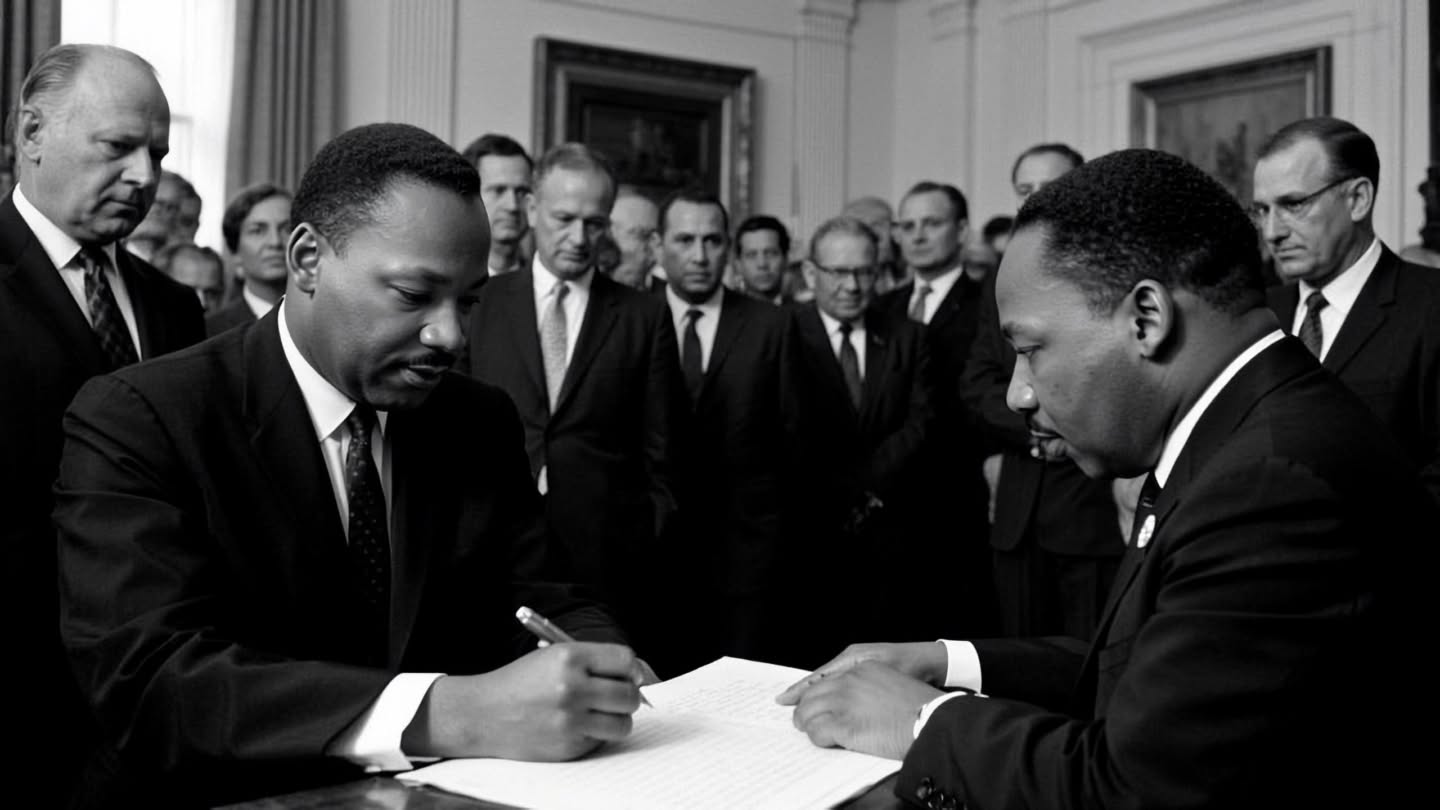
The Civil Rights Movement was a 14-year struggle that changed American law and society forever. Between 1954 and 1968, ordinary people used protests, courts, and new laws to end legal segregation in the United States.
1. The Start: Brown v. Board of Education (1954)
The movement got its legal start in the Supreme Court. In Brown v. Board of Education, the Court ruled that “separate educational facilities are inherently unequal.” This 9-0 decision ended the old “separate but equal” rule from 1896.
It meant public schools could no longer be segregated by race. But the ruling did not change things overnight. Many states resisted. In 1957, President Eisenhower sent federal troops to Little Rock, Arkansas to protect nine Black students entering a white high school. The case proved that courts could be used to challenge unfair laws.
2. The Montgomery Bus Boycott (1955-1956)
A year later, Rosa Parks refused to give up her bus seat in Montgomery, Alabama. Her arrest sparked a 381-day boycott of city buses led by a young pastor, Dr. Martin Luther King Jr.
Black residents, who were 75% of bus riders, walked or carpooled instead. The boycott hurt the bus company financially. In 1956, the Supreme Court ruled that bus segregation was unconstitutional. The boycott showed that peaceful economic pressure could work. It also made King a national leader.
3. The March on Washington (1963)
By 1963, the movement focused on national laws. On August 28, over 250,000 people gathered at the Lincoln Memorial in Washington, D.C. It was the largest protest in U.S. history at that time.
Dr. King gave his famous “I Have a Dream” speech, calling for an end to racism and for equality. The march put pressure on Congress and President John F. Kennedy to act. Images of the peaceful crowd were shown on TV across the world. The event proved that Americans supported civil rights.
4. The Civil Rights Act of 1964
After Kennedy’s assassination, President Lyndon B. Johnson pushed Congress to pass the Civil Rights Act of 1964. Signed on July 2, it was the most important civil rights law since 1875.
The Act banned discrimination in public places like hotels, restaurants, and theaters. It also banned job discrimination based on race, color, religion, sex, or national origin. The law created the Equal Employment Opportunity Commission to investigate complaints. It gave the federal government power to cut funding to segregated schools.
5. The Voting Rights Act of 1965
Even after 1964, many Black citizens could not vote. Some states used literacy tests, poll taxes, or intimidation to block them. In March 1965, protestors marched from Selma to Montgomery, Alabama for voting rights. TV cameras showed police attacking peaceful marchers on “Bloody Sunday.”
The public reaction was immediate. Five months later, Johnson signed the Voting Rights Act of 1965. It banned literacy tests and sent federal officials to register voters in states with discrimination. Black voter registration in the South jumped from 6% in 1965 to over 60% by 1969.
The Legacy
The Civil Rights Movement did not end all racism, but it ended legal segregation. It gave Americans legal tools to fight discrimination in courts. It also inspired other movements for women’s rights and disability rights.
The years 1954-1968 proved that nonviolent protest could change a nation. The laws passed during this time are still used today to protect equal access to schools, jobs, voting, and public services.
Key People to Know: Martin Luther King Jr., Rosa Parks, Lyndon B. Johnson, Thurgood Marshall.
Key Laws: Brown v. Board (1954), Civil Rights Act (1964), Voting Rights Act (1965).